University of Toronto
Helping New University Students in Toronto Make real Friends & Feel at Home
Role
UI Designer
UX Researcher
Skills
Experience Design
User Research
Timeline
Sept - Nov 2024
Team
Rishi Ashar (Me)
Harshita Verma (UXD Student)
Landuo Wei (UXD Student)
Elsie Dong (UXD Student)
Tools
 Miro
MiroOverview
A University Project Focused on Building Belonging Through Design
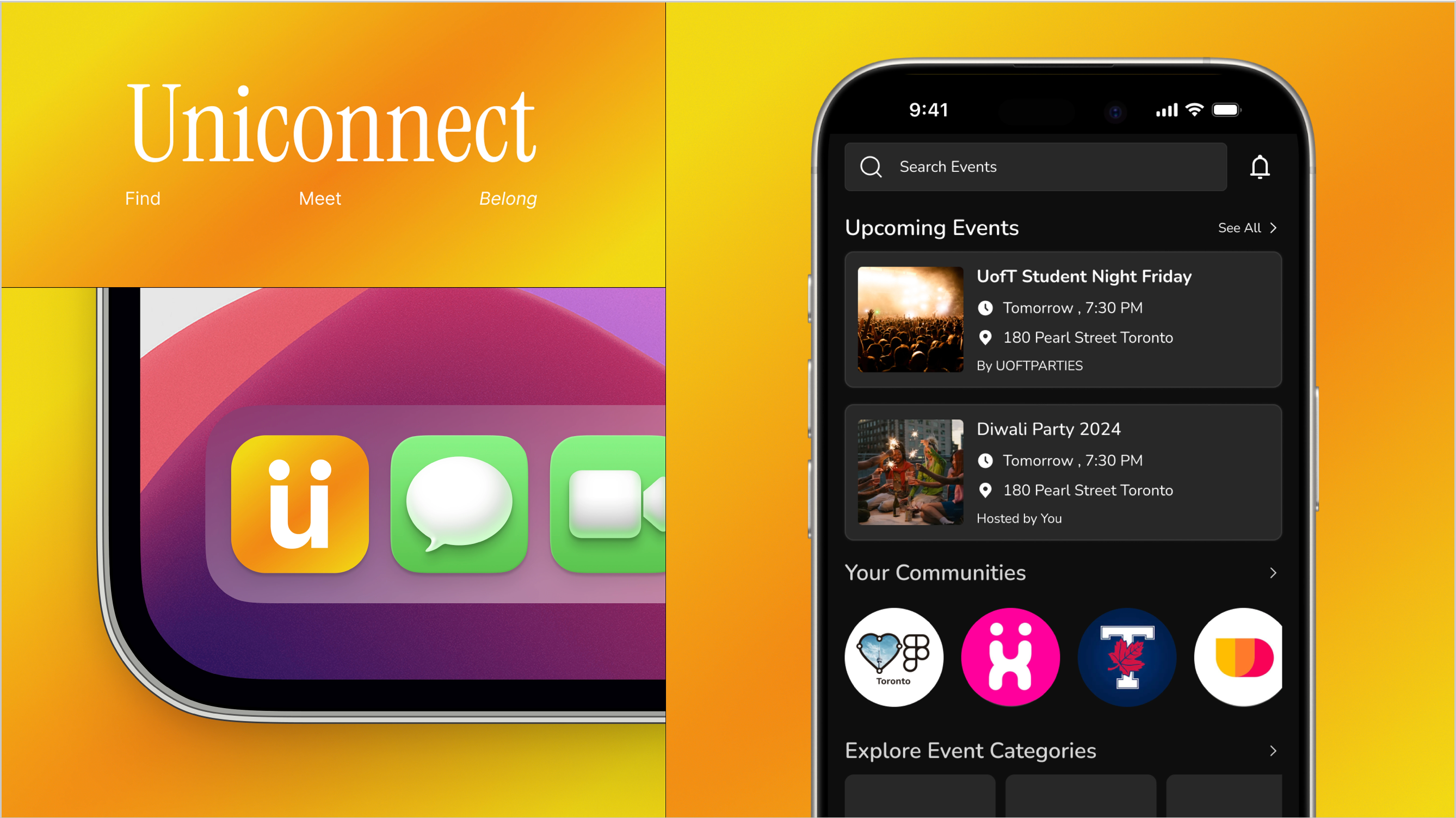
This project was part of my master's-level Fundamentals of UX course at the University of Toronto. Students were grouped based on chosen topics, which led to the formation of our four-member team focused on helping new and international students form meaningful connections. The goal was to design a digital platform that lets students find events, meet like-minded peers, and feel more included on campus.
Personal Wins
UI Design & Mentored Team mates
Guided two teammates through Figma, helping them learn interface design and prototyping during the early design phase, while owning the UI direction.
Conducted User Testing
Designed and facilitated usability tests with students, translating their feedback into refined layouts and smoother interactions.
Improved Team Coordination
Resolved workflow and communication issues within the group, ensuring smooth collaboration and timely project delivery.
The Problem(s)
Students Are Lonelier Than Ever
Nearly 70% of university students report feeling isolated on campus, with many struggling to find spaces where social interaction happens naturally. The absence of a dedicated social platform leaves new and international students disconnected from their peers.
Cultural and Social Barriers Limit Interaction
Students from diverse backgrounds often hesitate to initiate conversations, unsure of shared interests or social norms. This barrier prevents potential friendships from turning into real connections.
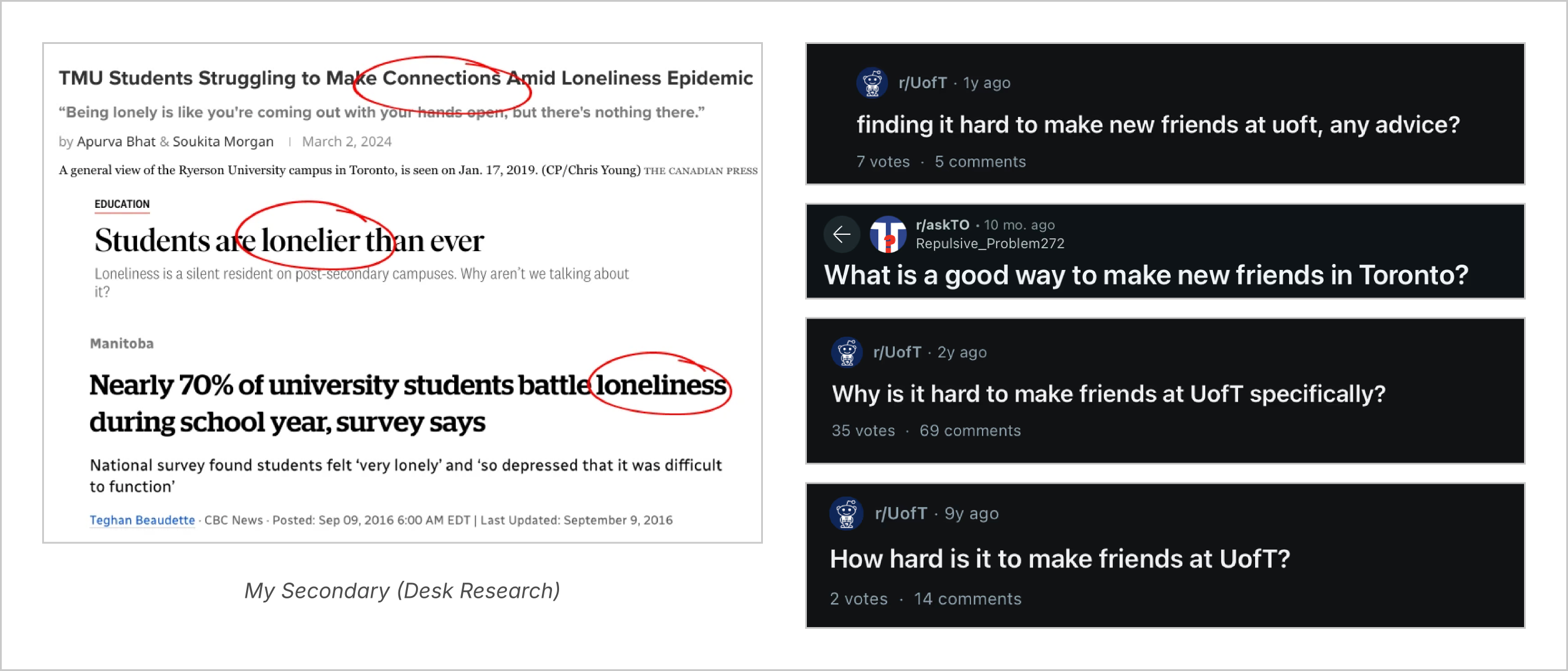
My Secondary (Desk Research)
Our Approach
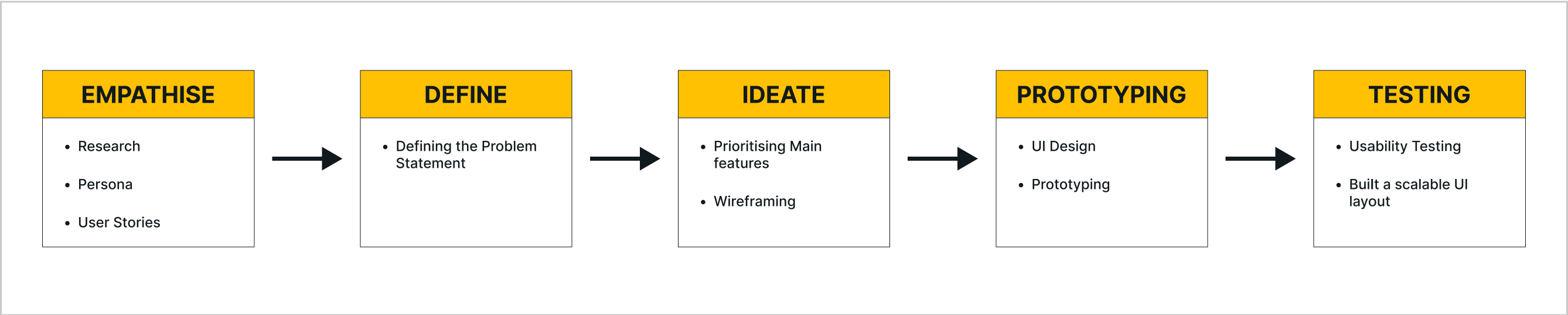
5 Step design Process
The traditional Double Diamond gave us a structure for diverging and converging. We adapted it into a 5-step process that fit our course workflow and team maturity. We spent more time understanding students and testing early ideas, because connection-forming is a behavior problem, not just a UI problem.
Discovery
Understanding How Students Try to Make Friends Today
As a team, we created a research plan focusing on three areas:
Major challenges students face when trying to make friends
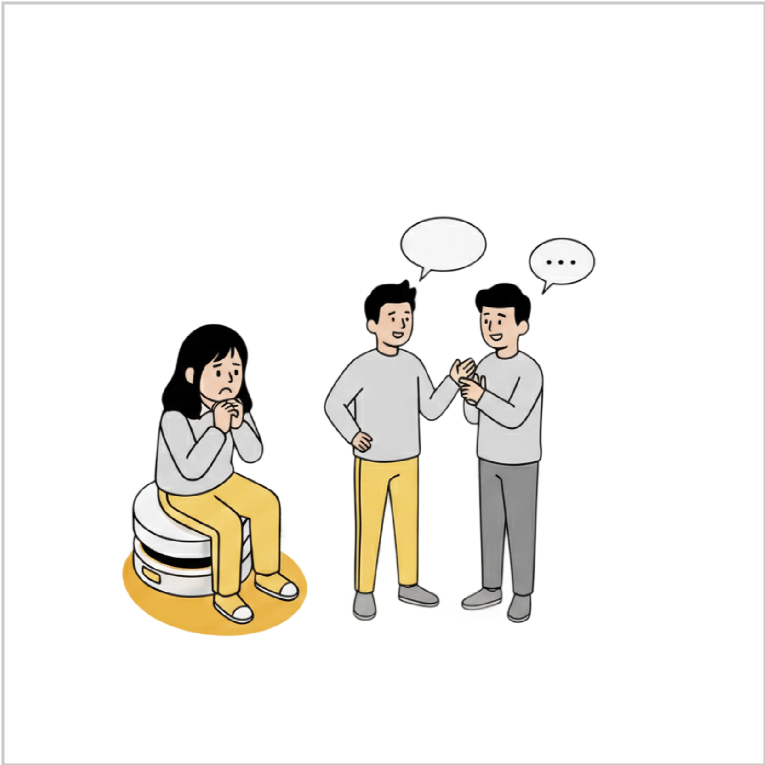
What they look for when building new connections
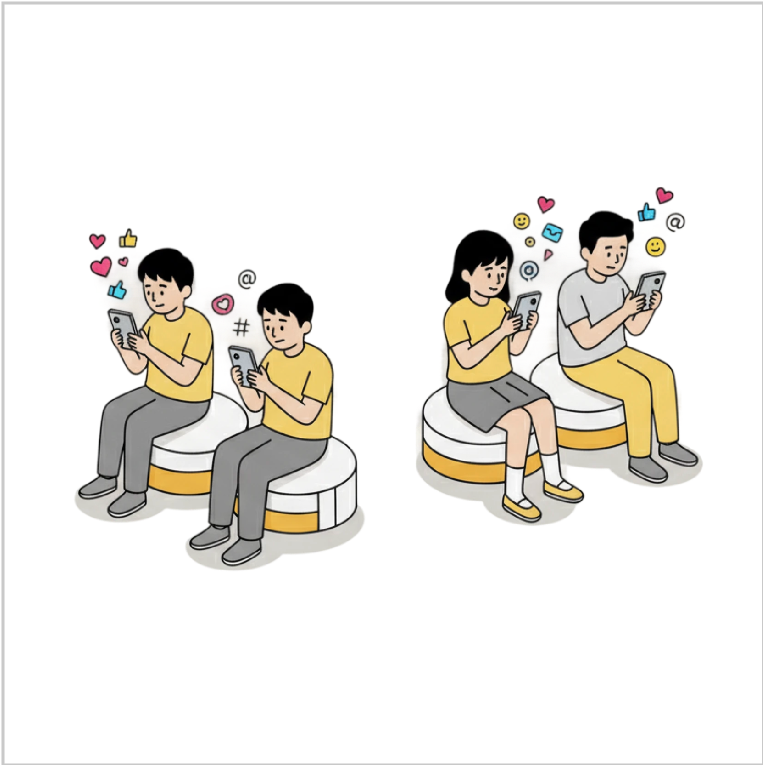
How they use social media to socialize
I proposed starting with the struggle itself to understand why forming friendships is difficult in the first place. I also suggested exploring the role social media currently plays in helping students meet people, so we could identify where it falls short.
We Spoke to Students About Their Real Experiences
We conducted 10 semi-structured interviews with international students aged between 18 - 26 who had recently moved to Canada and were studying at universities in Toronto.
My Contribution
Conducted 2 interviews with first-year international students to understand their early social challenges.
Some quotes from Participant 1

“How do I make friends in class when everyone is in hurry to get to the subway to avoid rush hour”
“I am really comfortable with someone who has same interests like me”
Some quotes from Participant 2

“I cannot find any events other than the ones hosted by the university”
“I want to make meaningful connections not just small talk”
What We Learned from Talking to Students
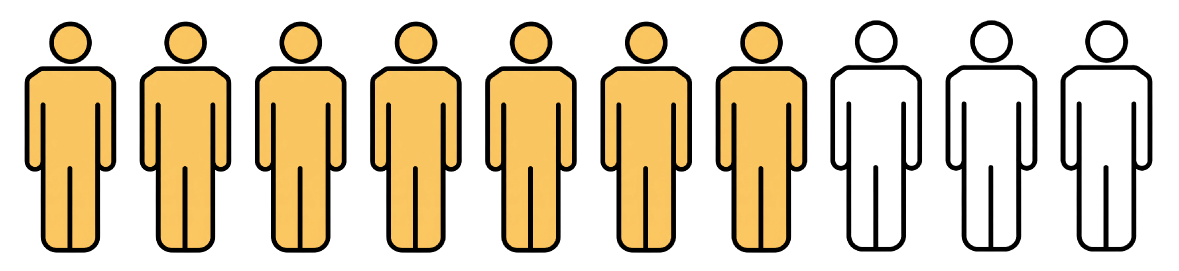
7 out of 10 participants struggled to break the ice during face to face interactions
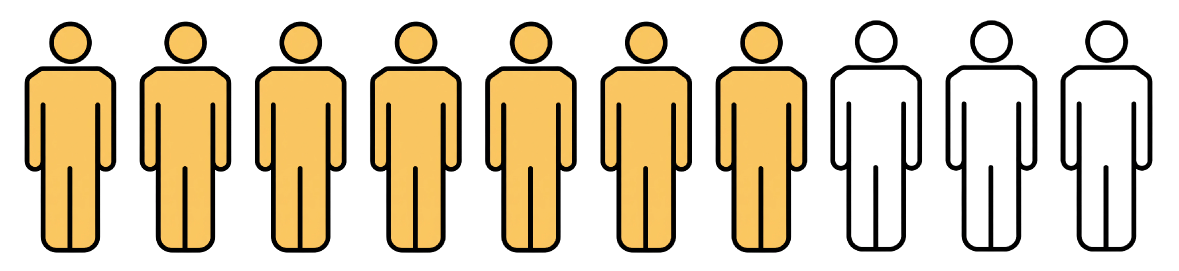
8 out of 10 participants made friends and meaningful connections through past events
Connected What Students Said to What They Needed
After completing secondary research, user interviews, and platform analysis, we gathered every insight and observation on one board. Using affinity mapping, we grouped similar thoughts, quotes, and challenges to uncover the bigger picture. This helped us see how scattered experiences connected and revealed the key themes that guided our design direction.
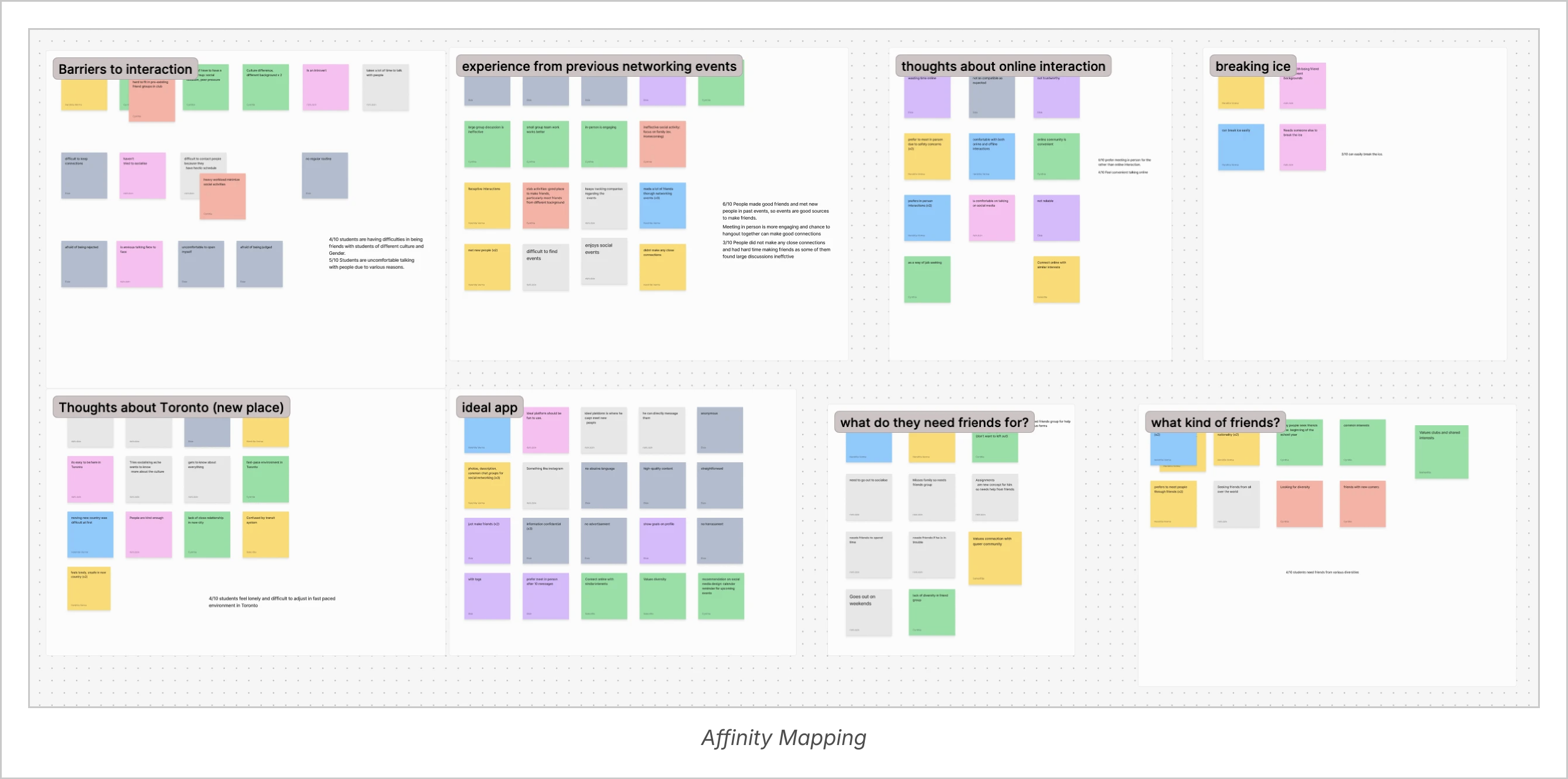
Affinity Mapping
Three Truths That Shaped Our Design Direction
From the affinity mapping, three major insights emerged that shaped how we approached the design:
1.Forming new friendships can feel overwhelming.
People relocating to new cities or joining UofT from outside Toronto often struggle to initiate conversations. This is not limited to introverts. Even extroverts find it difficult in unfamiliar environments.
2.Finding people with similar interests makes connection easier.
Students feel more confident and open when they meet others who share their passions or academic interests. Shared interests act as an easy bridge to start conversations.
3.Events play a crucial role in building new connections.
Events create natural settings for interaction, helping students meet people in a relaxed environment where conversations happen more organically.
Define
Who We Designed For, meet Emily!!
After identifying the key insights, we wanted to see the research through a real person's story. We pictured what it feels like to arrive in a new city, surrounded by people but unsure how to start a conversation. That became Emily, a first-year international student who reflects what many go through at UofT. She is curious, hopeful, and trying to find her place. Her goals and frustrations helped us design with empathy and stay focused on what students genuinely need.
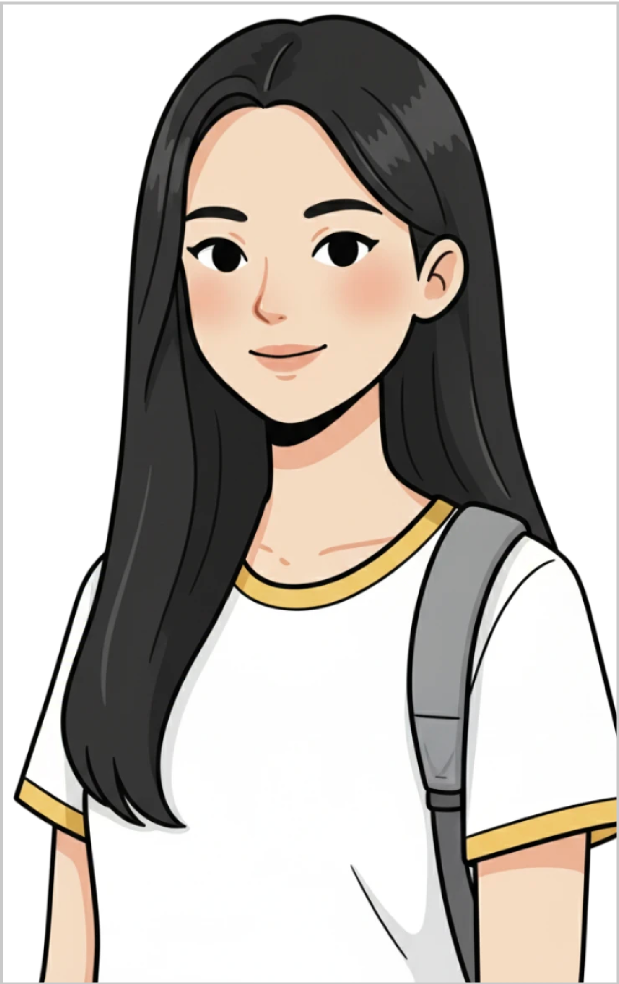
Emily Chen
23 Year old 1st Year PhD Scholar
Goals
Make new friends and build meaningful connections. Find structured ways to meet people instead of relying on small talk. Explore social events and city hotspots to feel more connected.
Barriers
Feels uncertain about initiating conversations due to a different cultural background. Struggles to navigate scattered event listings. Notices other students already forming groups, making it harder to break in.
What Emily's Experience Revealed
We mapped Emily's experience to understand how her feelings and challenges changed from the moment she arrived on campus to when she started feeling disconnected. Each stage showed what students like her go through while trying to find friends and settle into a new place.
| Stages | Arriving on Campus | First Few Days | Social Struggles | Feeling Disconnect |
|---|---|---|---|---|
| action | Moves to university residence | Attends orientation but does not form strong connections | Attempts to meet people through classes or social spaces | Starts spending more time alone, avoiding social events |
| Painpoints | Feels isolated and overwhelmed | Hard to find like-minded people in groups | Fear of rejection and social anxiety | Feels discouraged and might give up socialising |
| emotion | Hopeful | Uncertain | Anxious | Disconnected |
The journey moved from excitement during orientation to frustration when connections did not come easily. It helped us see where design could support her better by reducing social anxiety, creating easier ways to meet people, and encouraging her to keep engaging with her community.
Framing the Challenge
After uncovering what students were struggling with, we framed the core problem our design aimed to solve.
How might we create a digital platform that empowers new university students to make new connections with like-minded people within the university?
Design
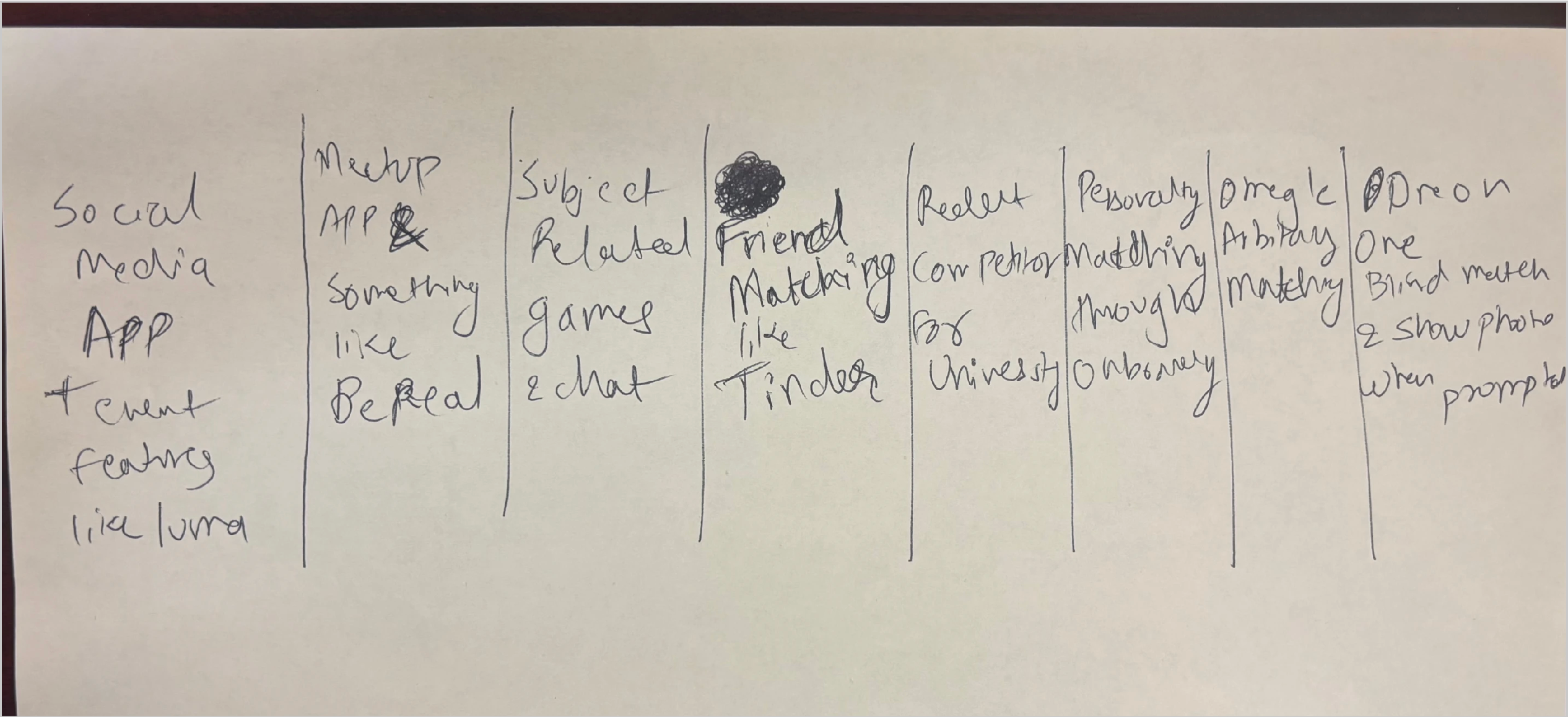
Explored Ideas Through Crazy 8s
After defining the problem, we moved into ideation. Each team member took part in a Crazy 8s exercise to quickly sketch different ways students could discover events and connect with others. This rapid process helped us generate diverse ideas before deciding which ones to take forward into prototyping.
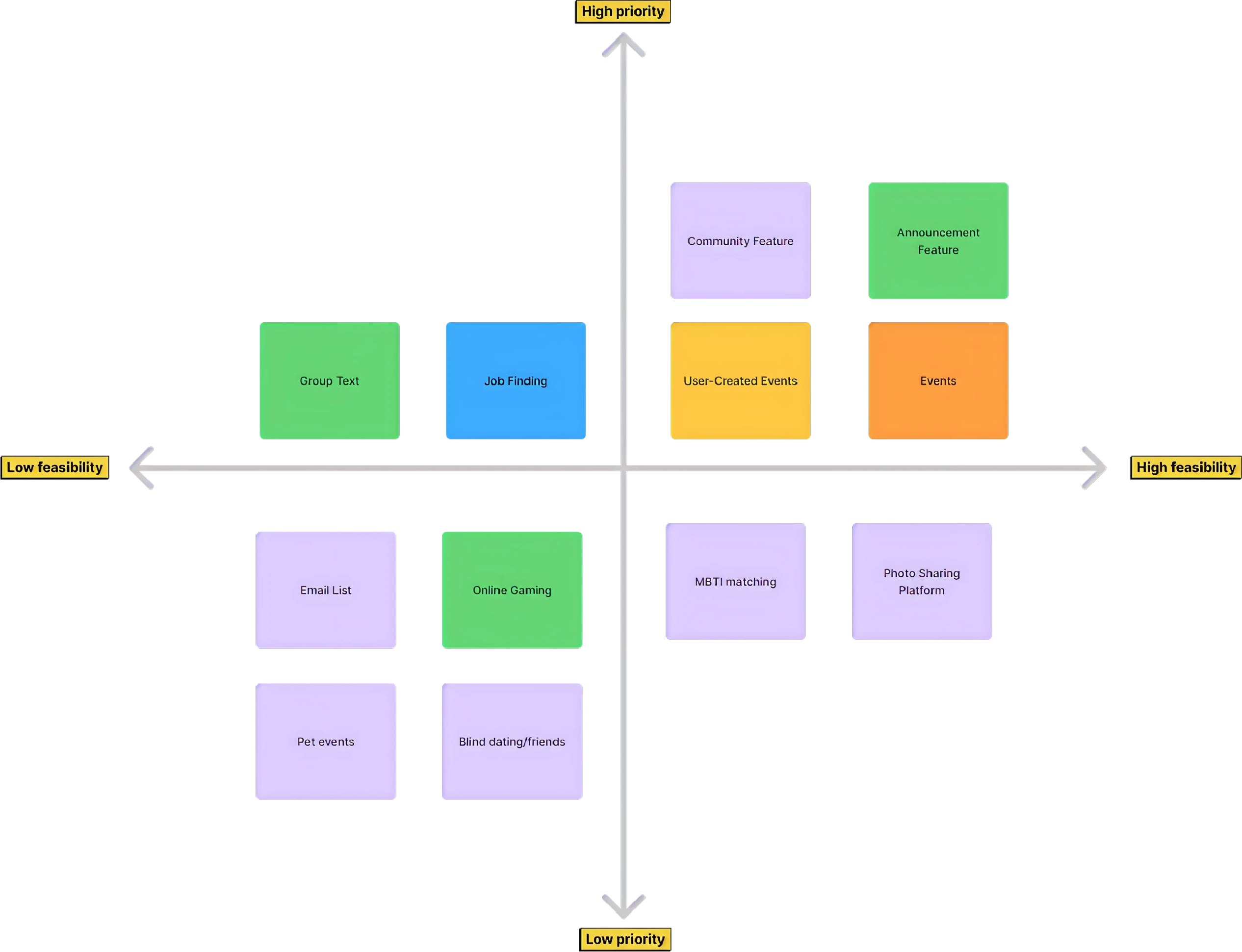
Prioritized Ideas Using a Feasibility-Impact Grid
After generating multiple ideas from the Crazy 8s session, we plotted them on a priority grid to evaluate each concept's impact and feasibility. This helped us focus on ideas that balanced value for students with realistic implementation.
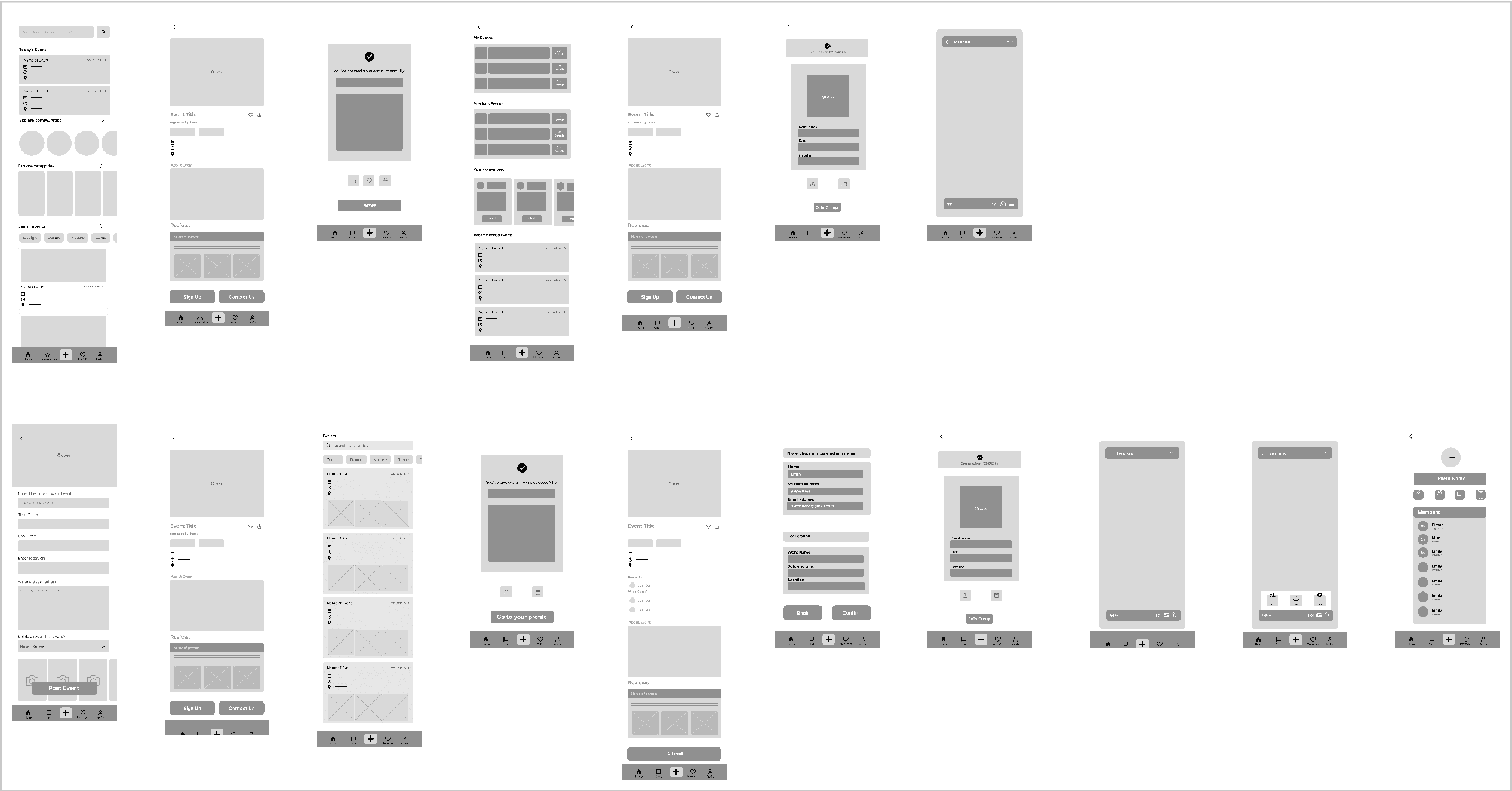
Created Wireframes to Visualize the Experience
Once we finalized our ideas, we sketched low and mid-fidelity wireframes to see how the app would actually look and work. This helped us map out the main screens, test the flow, and fix any confusing parts before moving to detailed design.
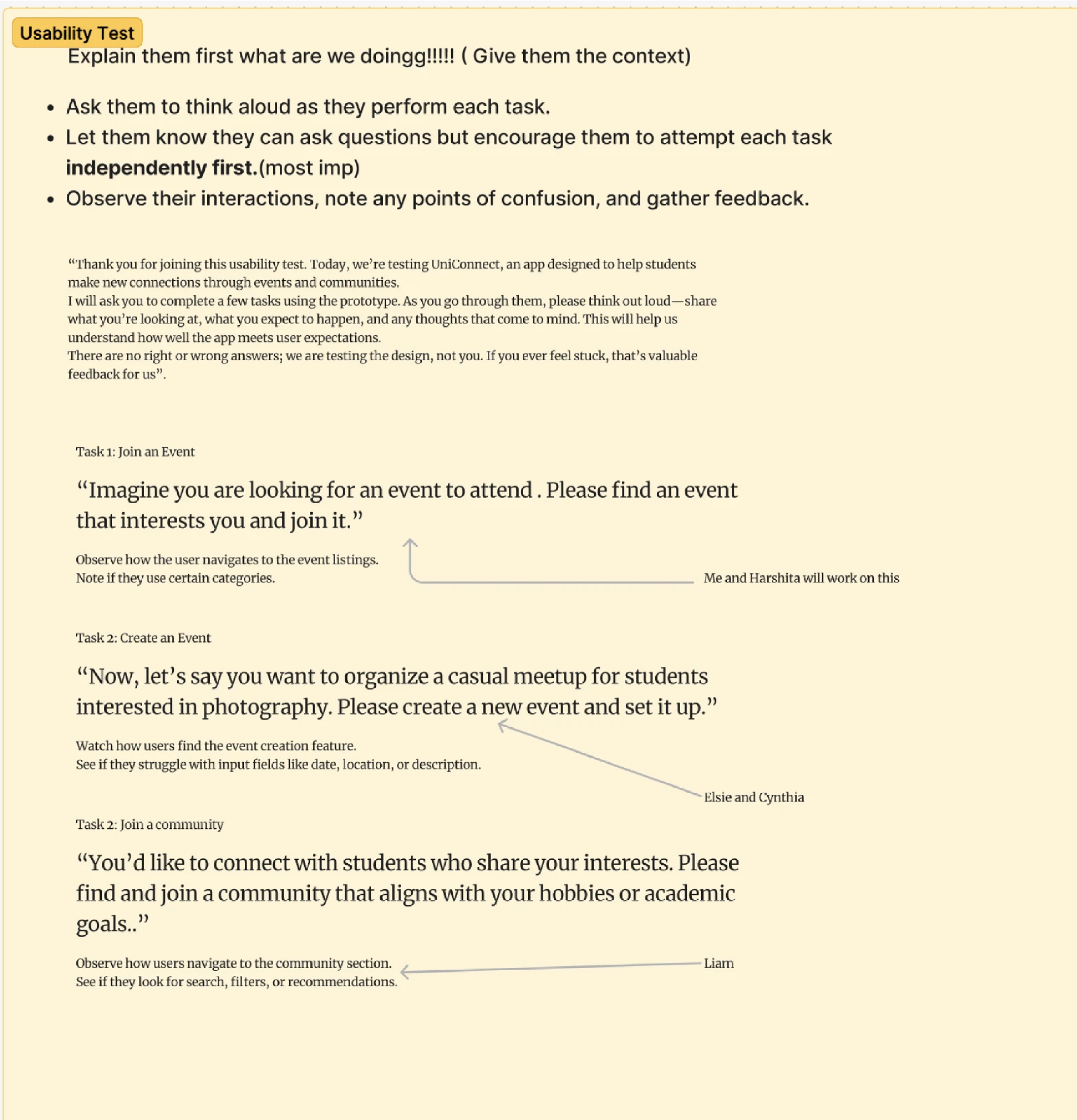
I Planned User Testing to Validate the Ideas
After creating the wireframes, I wanted to see how real students would interact with them. I designed a user testing plan to observe how easily they could navigate the flow, whether the features felt helpful, and where they faced confusion while using the app.
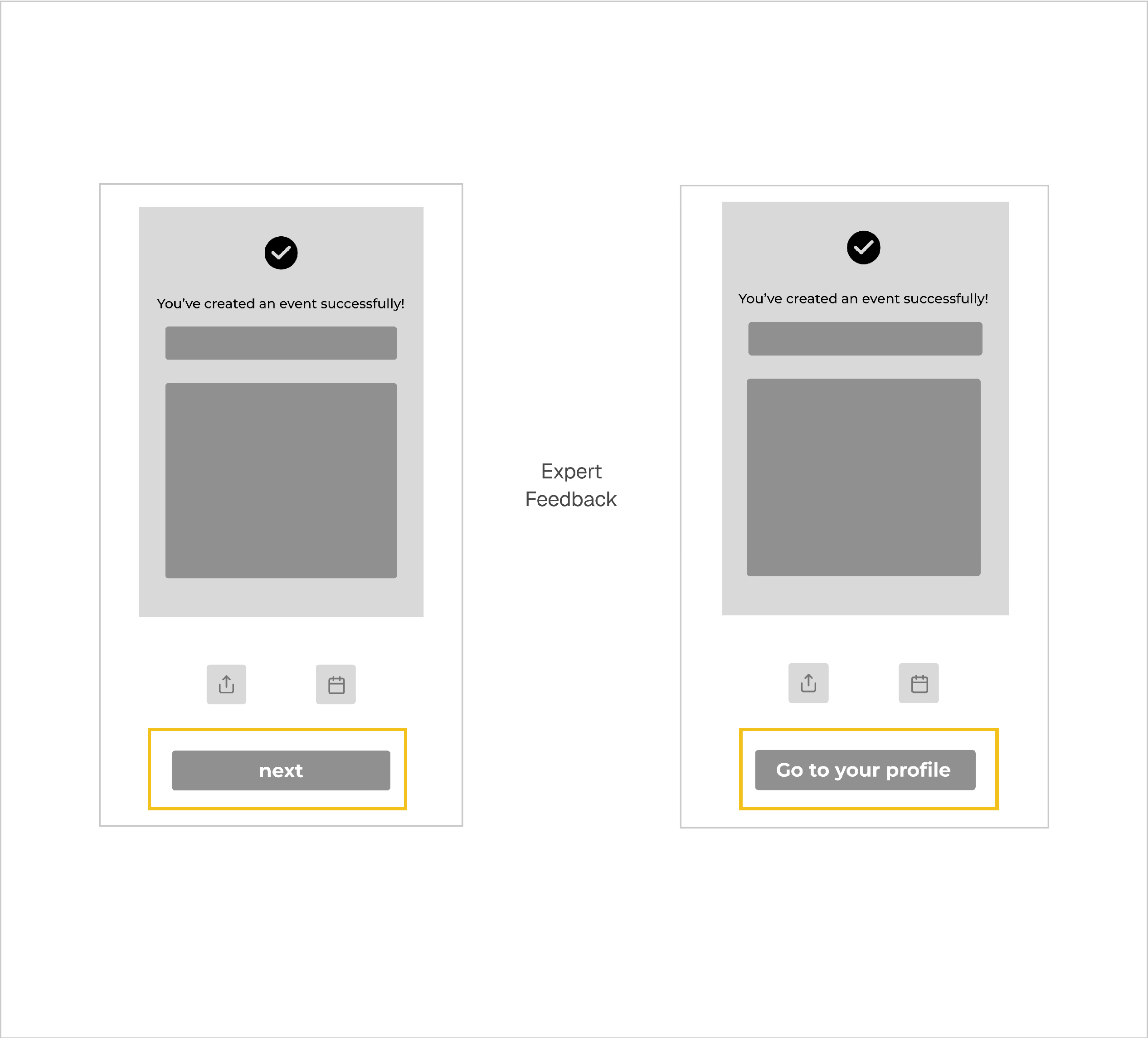
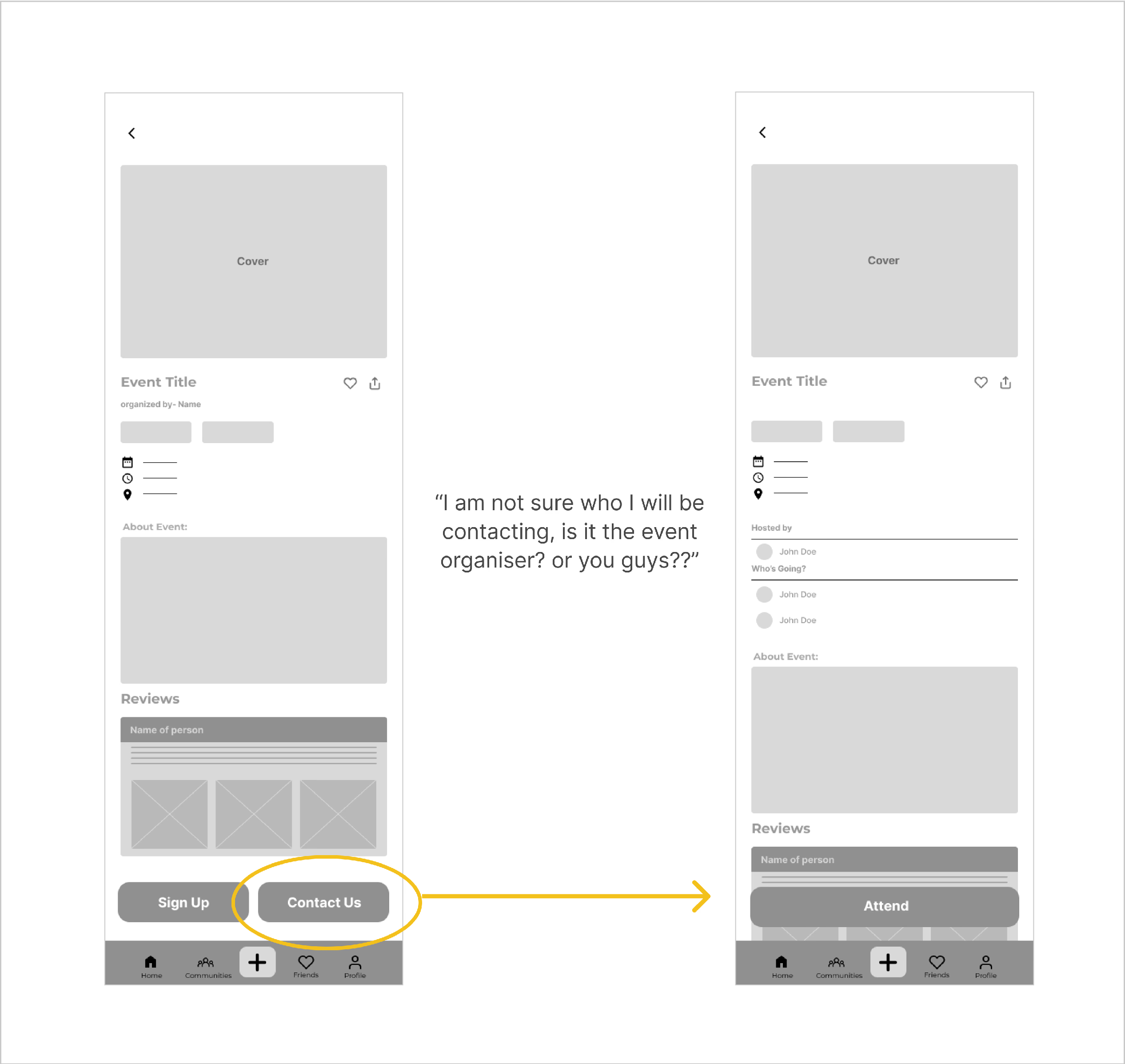
Refined the Design Through User Feedback
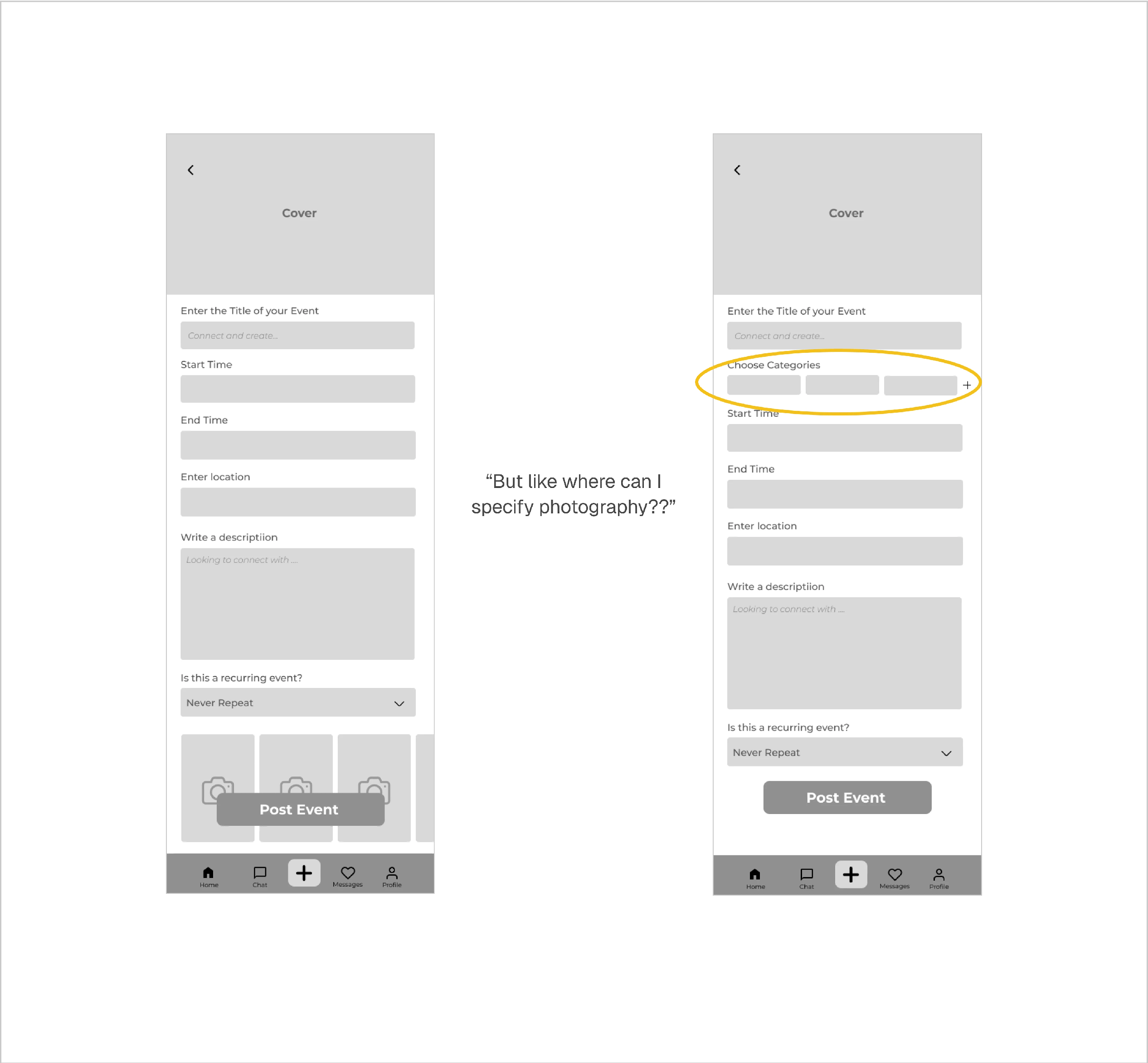
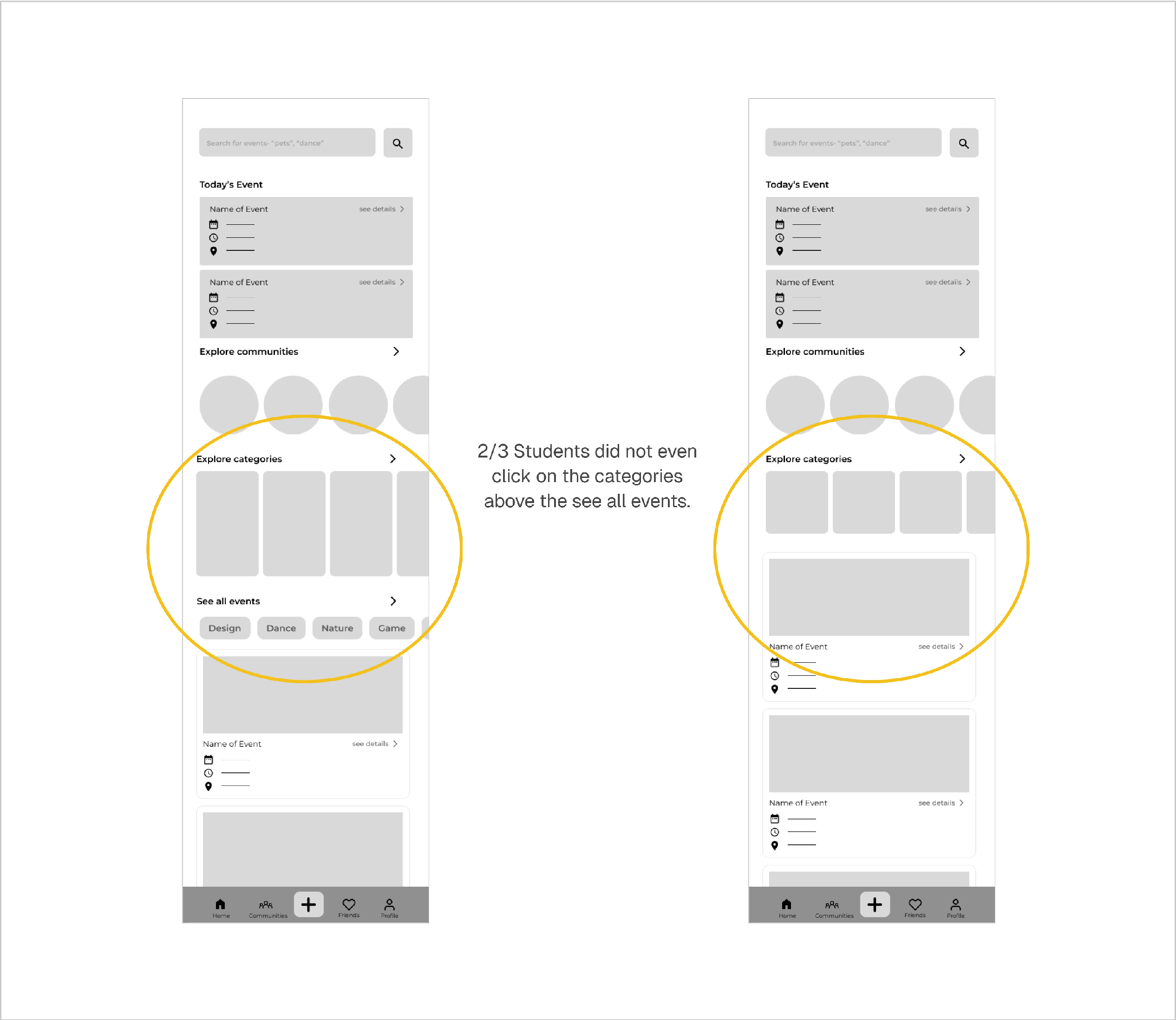
Turning Research Into Product Flows
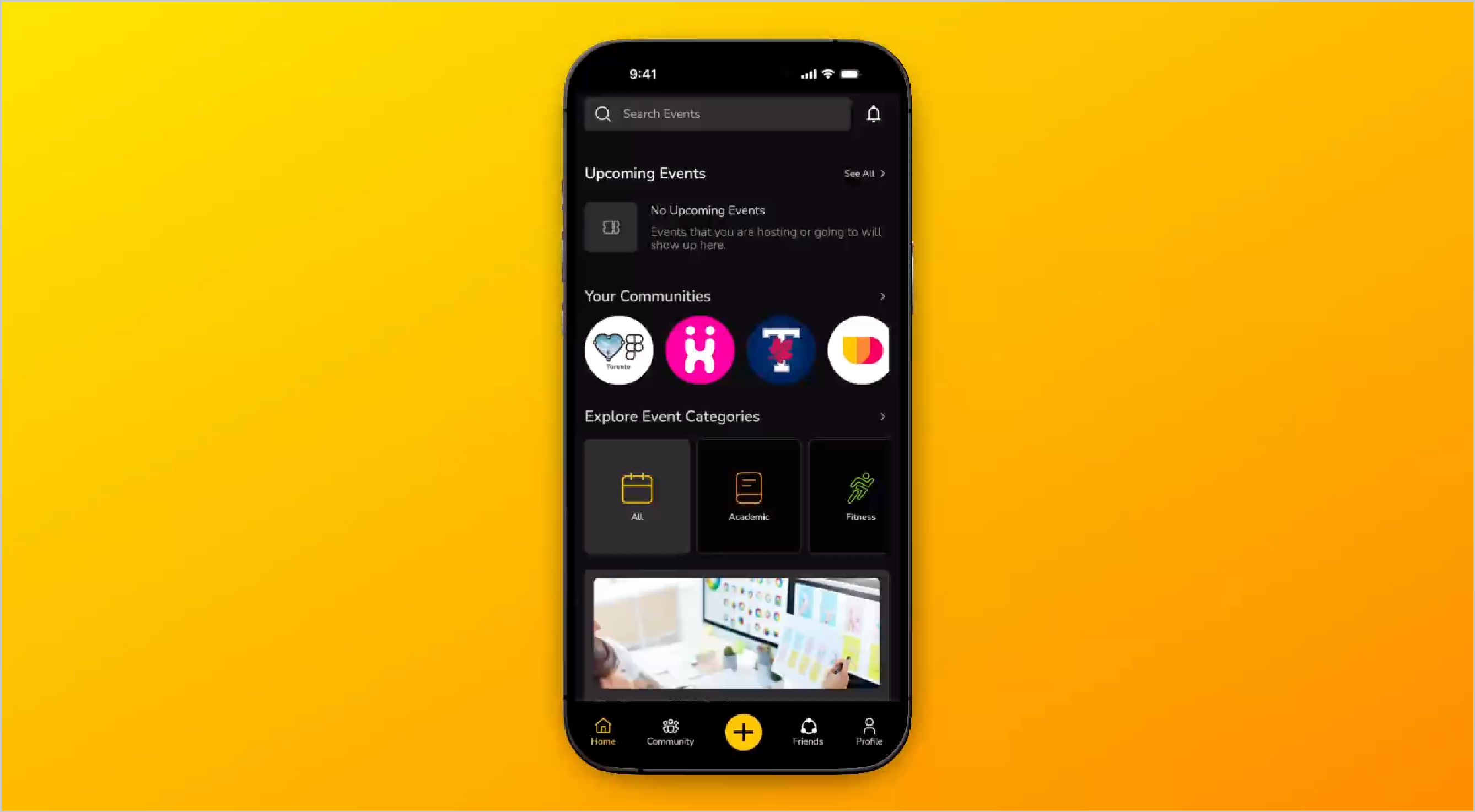
We prioritized flows that lowered the effort of joining something new: searching for events, reading event context, seeing communities, and saving a spot before showing up in person.
Find
Students can discover social events across campus and the city instead of relying only on official university listings.
Meet
Communities and event pages make it easier to see who is going, what the vibe is, and where shared interests exist.
Belong
The experience supports repeated participation so students can move from one-off interactions to real friendships.
Deliver
Deliver
We Designed a Moodboard to Define the Visual Direction
After finalizing our wireframes, we created a moodboard to establish the visual tone of the product. I led this phase by defining key vision words that captured the feel we wanted to evoke. Each teammate contributed images reflecting those themes, and together we refined them into a unified visual direction that guided our final UI design.
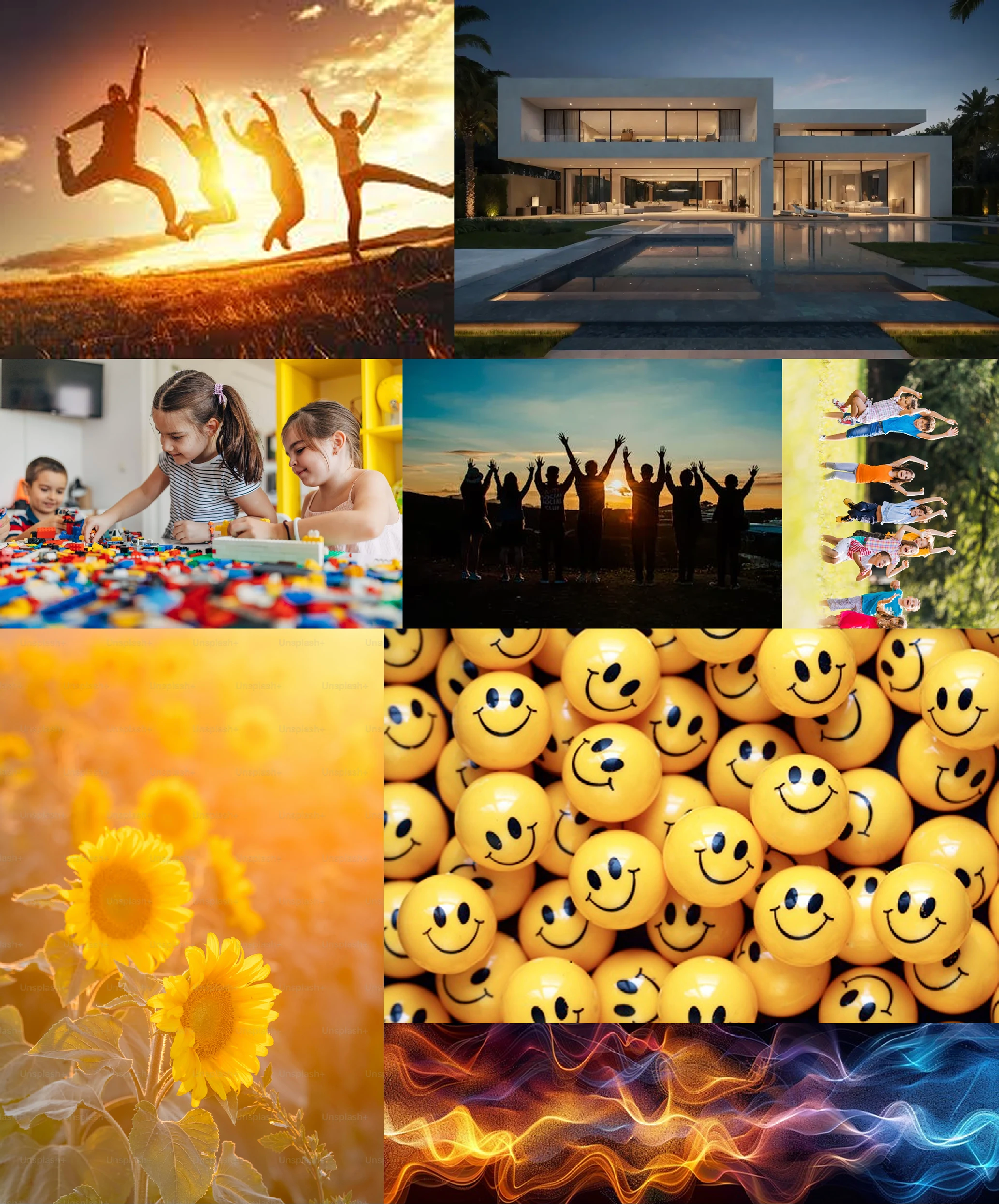
I Defined the Color Palette to Capture the Right Energy
I took the lead in developing the color palette for our design. I used a simple technique where I squinted at the moodboard to spot which colors stood out the most. That helped me identify yellow as the primary color on a dark background. This choice reflected the bright and energetic vibe of campus events while keeping the design clean and modern.
This palette represents
Happiness
Warmth
Confidence
Belonging
AaBbCcDd123!@#
Nunito Bold 24 Px
Nunito Semibold 20 Px
Nunito Medium 16 Px
Nunito Regular 14 Px
Nunito Regular 12 Px
Effortless Event Participation and Social Connection
Makes it easy to join events and connect with like-minded people.
- Detailed event profiles help users decide which events to attend.
- Pre-event socializing shows who else is attending, making it easier to interact before the event.
- A streamlined signup process removes repeated form entry and keeps the experience hassle-free.
Create Events
Makes it easy to create events by giving students a simple way to bring people together.
- Find on-campus venues and free locations, creating more opportunities to connect.
- Use an easy two-step event creation flow and quickly invite friends to join.
Event Discovery
A searchable home feed helps students find campus events, hosted parties, and local activities in one place.
Communities
Community hubs give students repeated spaces to participate, making it easier to move beyond one-time interactions.
Confidence to Join
Event details, tags, hosts, and attendance cues reduce uncertainty before a student decides to show up.
What I Took Away
UniConnect taught me that social products are not only about adding more places to meet people. They have to reduce the emotional effort of starting. The strongest design choices were the ones that made taking the first step feel less awkward, more contextual, and more human.